
Installed base, maintenance contracts, F-Gas, refrigerant log
Air conditioning, heat pumps and refrigeration.
Every unit you install has its due date, its maintenance contract and its history. The technician closes the job on their phone with the customer's signature, and the CERFA form and the refrigerant log fill themselves in on close.
30-day online trial, no card.
The software
Three screens, taken from the application.
- Dashboard HVAC
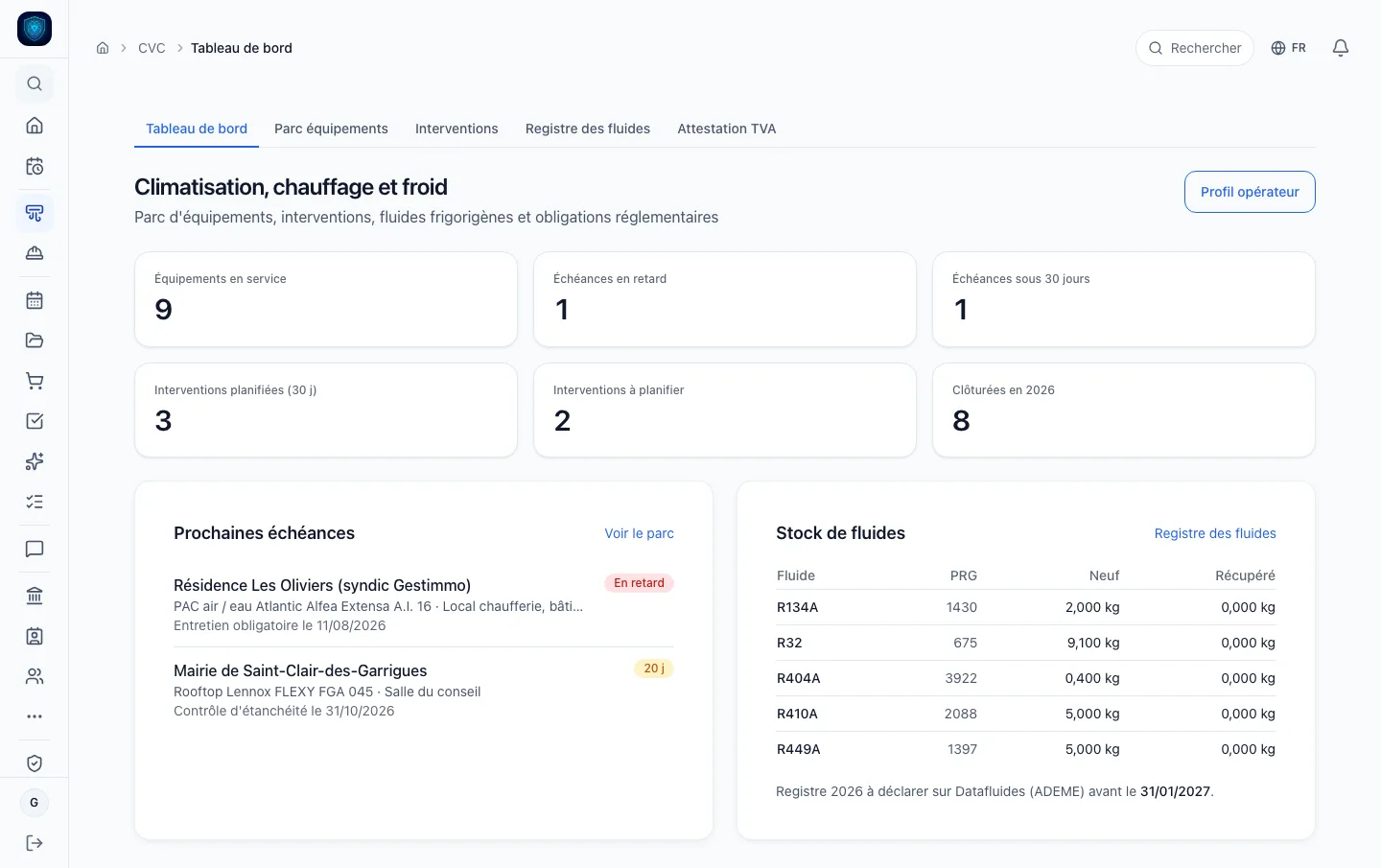
Overdue and upcoming deadlines, jobs to schedule and refrigerant stock, all in one place.
- Installed base HVAC
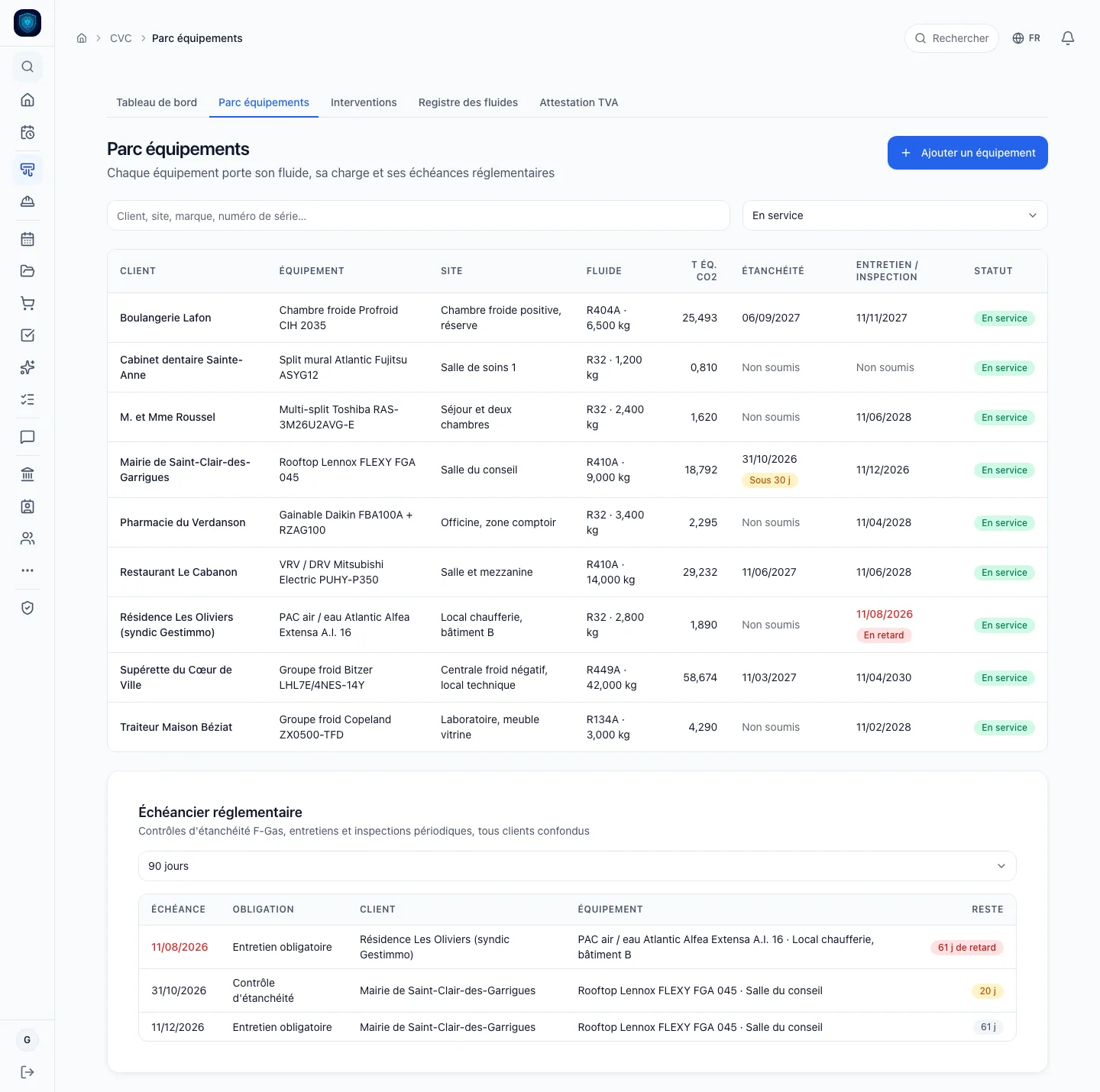
Every installed unit with its refrigerant, its tonnes of CO2 equivalent and its next regulatory due date.
- Refrigerant log HVAC
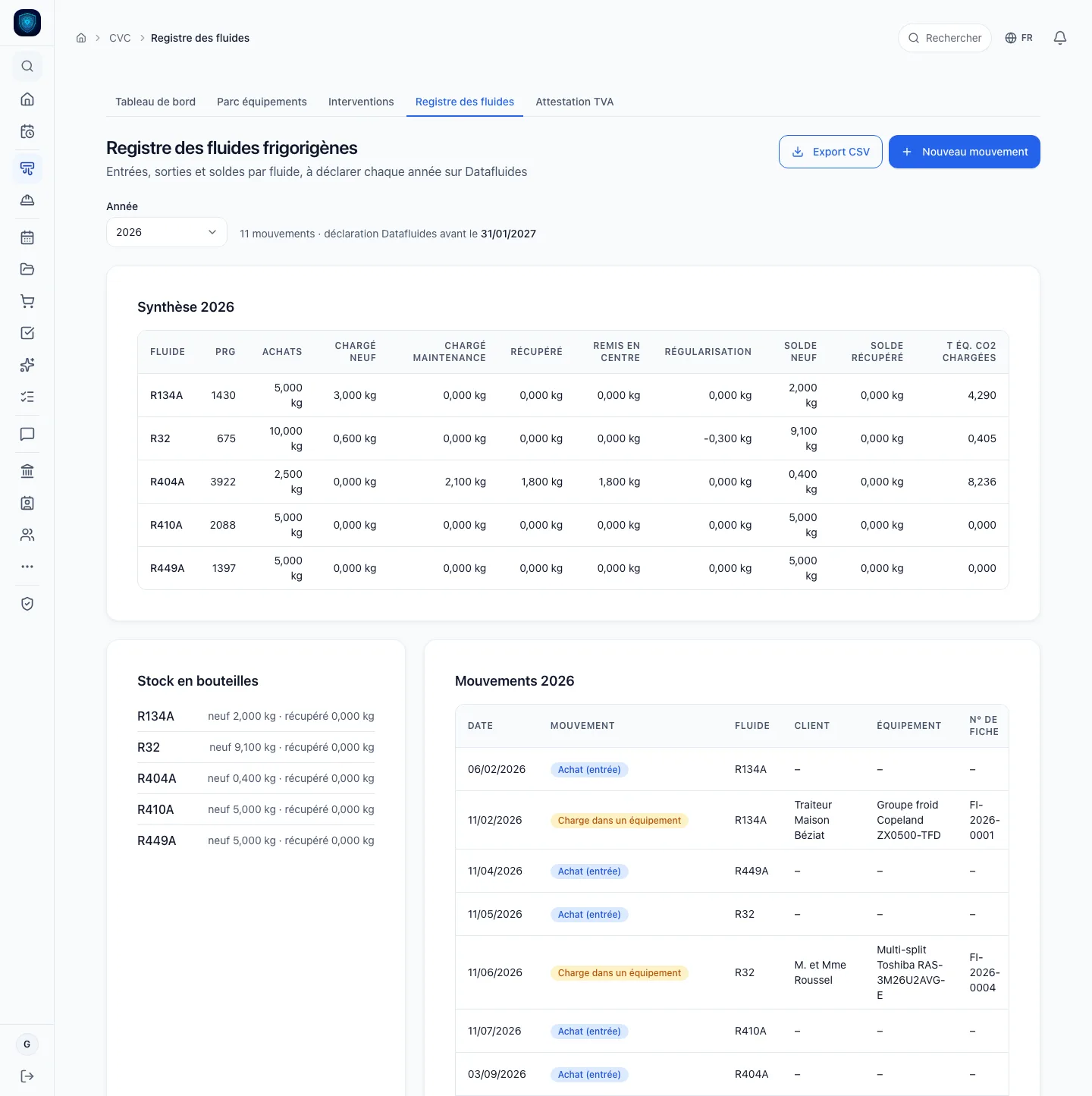
The year's movements and the summary under the Datafluides declaration headings.
- Maintenance contracts HVAC
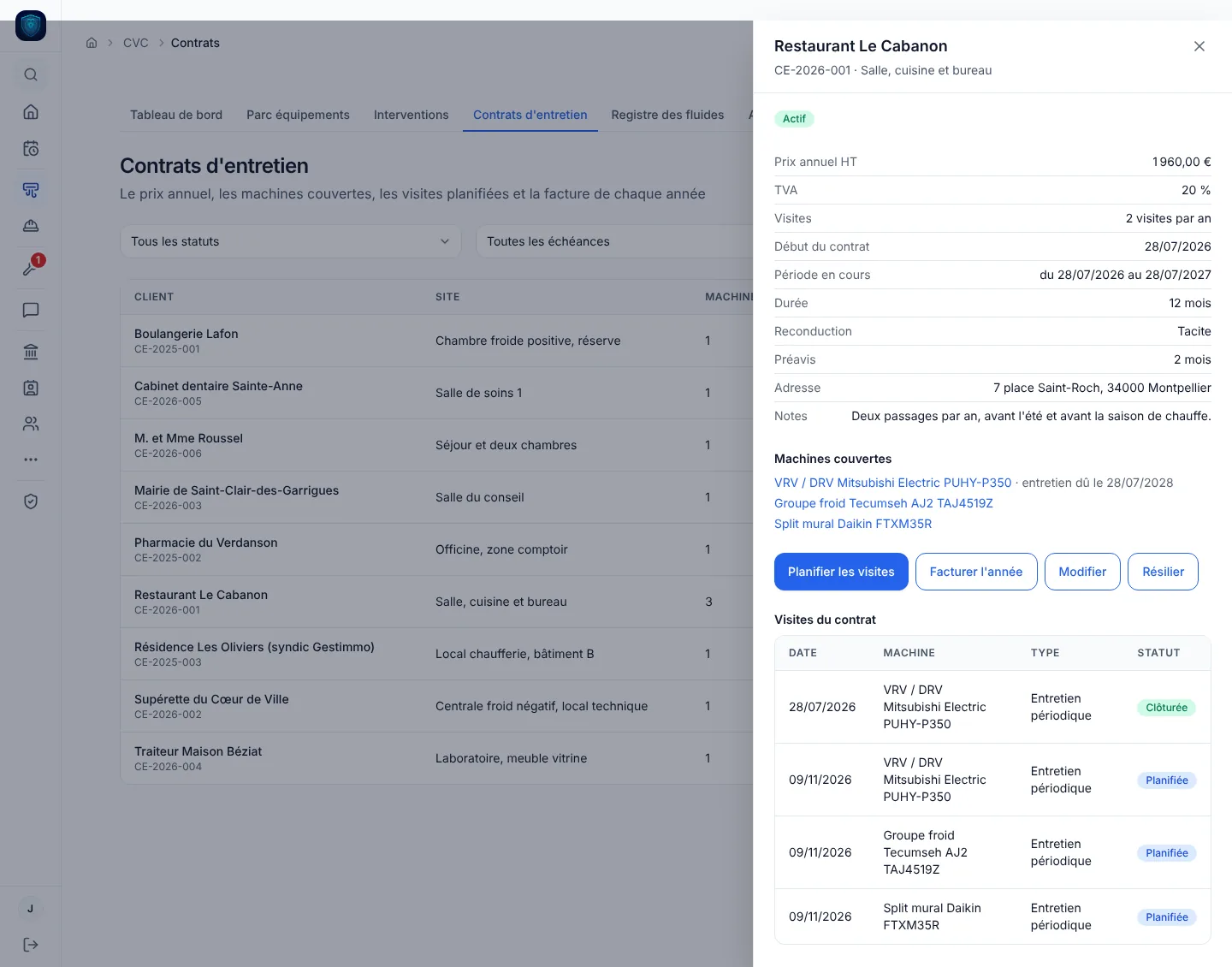
Each maintenance contract with its annual price, the units it covers and its visits, done or scheduled.
Real screenshots of the software · the data is that of a demonstration instance.
Your plan
Heating and air conditioning
The HVAC module is included at no extra cost.
6 modules tuned for this trade, switched on from day one.
- HVAC included
- Worksites & field service
- Quotes & Factur-X invoicing
- Scheduling, HR & payroll
- Expenses & OCR
- Accounting & FEC
Building trades
Other trades in this family.
Each one has its own page, with its real screens and its price.
Where it hurts
Before, after.
-
« I can no longer tell which refrigeration unit is due for its leak check this quarter. »
The due date works itself out.
Details
Refrigerant and charge give the tonnes of CO2 equivalent, and the tonnes give the frequency: every twelve, six or three months, doubled when the unit has a leak detection system. The schedule puts the most urgent first.
-
« My maintenance contracts live in a binder, and I redo the invoice every year. »
The contract covers a customer's units on one site, with its annual price, term, notice period and tacit renewal.
Details
In one click it adds the period's visits to the planned jobs, and it raises the period's invoice, one line per unit. Sixty days before the end, it turns "due for renewal".
-
« The technician comes back with paper reports and no customer signature. »
On their phone, they see today's visits and any overdue ones.
Details
They photograph the installation, record the check result and the refrigerant charged or recovered, then the customer signs with a finger. Without a signature, the app will not close the job.
-
« Every January I rebuild a whole year of refrigerant log for the declaration. »
The log is kept as the year goes.
Details
Every charge and every recovery goes in when the job is closed, and purchases and returns to a treatment centre are added alongside. The annual summary follows the Datafluides headings, and the dashboard reminds you of the 31 January deadline.
2 more pains we cure
-
« I fill in the CERFA form by hand in the van, and half the boxes stay empty. »
The form comes out of the job close.
Details
Refrigerant charged or recovered, cylinder number, check result, technician: it all flows from the job into the CERFA 15497 form as a numbered PDF. A leak check with no result cannot be closed.
-
« My refrigerant handling certificate runs out, and I find out the day someone asks for it. »
Number, category, issuing body and expiry date sit in your operator profile.
Details
The day it expires, the dashboard shows it in red, and the OS will not issue a job report or a servicing certificate until it is renewed.
In detail
Everything that ships built in.
- Banking Qonto
- Accounting and tax PennylaneBeta · Silae · Chorus ProBeta
-
The installed base
- Unit record
- Twelve unit types
- Tonnes of CO2 equivalent
Details
- Unit record: customer, site, make, model, serial number, power, refrigerant and charge
- Twelve unit types: split, ducted, VRF, rooftop, air-to-water or ground-source heat pump, chiller and cold room
- Tonnes of CO2 equivalent: worked out from the charge and the refrigerant GWP
- History per unit: jobs, leaks and top-ups on the unit's record
- Removal: the unit leaves the base on close, with recovered refrigerant required
-
F-Gas and servicing due dates
- Leak check
- Leak detection system
- Hermetically sealed unit
Details
- Leak check: every twelve, six or three months, depending on tonnes of CO2 equivalent
- Leak detection system: the check interval is doubled
- Hermetically sealed unit: exempt below 10 tonnes of CO2 equivalent
- Servicing from 4 to 70 kW: every two years, with a certificate
- Inspection above 70 kW: every five years, shown separately
- Schedule: overdue or upcoming, most urgent first, filtered by horizon
-
Maintenance contracts
- Covered units
- Tacit renewal
- Generated visits
Details
- Covered units: one customer, one site, their equipment
- Tacit renewal: term, notice period, annual price before VAT
- Generated visits: added in one click to the planned jobs, no duplicates
- Period invoice: as a draft, one line per unit, only one per period
- Frequency: never further apart than the obligation of a covered unit
- Due for renewal: flagged sixty days before the end of the period
- Renewal notice: by email before the notice deadline, then a reminder
- Created from the unit record, or for all of a customer's units
-
In the field
- Today's visits
- Photos
- Customer's signature
Details
- Today's visits: in the technician's PrivateCore app
- Photos: the installation attached to the job
- Customer's signature: with a finger, required to close
- On-site entry: notes, leak check result, refrigerant charged or recovered
- Assigned technician: a colleague cannot close their job
-
Reports, certificates and VAT
- CERFA 15497 form
- Servicing certificate
- Safeguards
Details
- CERFA 15497 form: numbered on close, as a PDF
- Servicing certificate: numbered, as a PDF, with its seven checkpoints
- Safeguards: no leak check closed without a result, no removal without recovered refrigerant
- Operator profile: handling certificate, category, issuing body, Datafluides ID
- VAT certificate: the rate, its reasons and the wording that replaces form 1301-SD
- Job types: commissioning, servicing, leak check, repair, top-up, removal
-
Refrigerant log
- Movements
- Automatic entries
- Annual summary
Details
- Movements: purchase, charge, recovery, return to a treatment centre, adjustment
- Automatic entries: closing a job records the charge and the recovery
- Annual summary: under the Datafluides declaration headings
- Cylinder stock: new and recovered, refrigerant by refrigerant
- CSV export: the year's log, ready to transfer
The math
What it replaces, and what it costs.
Typical case: trades company, 4 workers, parallel job sites.
What the plan covers
- Construction quotes & invoices Obat €59 or Batappli · Tolteck · EBP Bâtiment
- Job site tracking Alobees €89 or Finalcad · Kraaft · Archipad
- Payroll (4 payslips) Outsourced firm €100 or PayFit · Silae · Sage Paie
- Accounting & FEC Pennylane €49 or Tiime · Indy · Sage
- Site expense claims Expensya €25 or N2F · Jenji · Mooncard
PrivateCore
Heating and air conditioning
€153 a month
5 subscriptions, one plan.
And what the usual stack does not cover
- Factur-X & Chorus Pro
Public prices as of August to October 2026, entry-level plans, options excluded. The vendors' prices change: check their sites.
The gap
What we centralise, and they do not.
-
The refrigerant log
The log is written each time a job is closed, and the annual summary already follows the Datafluides headings.
Elsewhere A spreadsheet kept on the side, copied from paper reports, reworked in January for Datafluides.
-
The job report
The technician closes on their phone with the customer's signature.
Elsewhere A paper pad of CERFA 15497 forms, filled in in the van, signed when someone remembers, filed in a binder.
Details
The report is numbered and stays attached to the unit.
-
The maintenance contract
The contract adds its visits and raises the period invoice, from the units it covers.
Elsewhere A binder of contracts, a diary for the visits and an invoice redone by hand every year.
2 more differences
-
Due dates
The due date is worked out from refrigerant, charge and power, and recalculated after every job.
Elsewhere A diary where you write down the next check yourself, unit by unit.
-
Quotes and invoices
Quotes, invoices, job sites and the installed base live in the same management OS.
Elsewhere A building-trades quoting tool, kept apart from unit tracking and the log.
FAQ
What we get asked.
Does the HVAC module cost extra on top of the trades pack?
No. It is included in the building trades pack at no extra cost. It is switched on at installation when you pick heating and air conditioning as your trade, alongside job sites, invoicing, payroll, expenses and accounting.
Does the module handle maintenance contracts?
Yes. A contract covers one customer, one site and their units, with an annual price, a term, a notice period and, if you want it, tacit renewal. The OS refuses a visit frequency further apart than the obligation of a covered unit. It adds the period's visits and raises one invoice per period. Sixty days before the end, the contract turns "due for renewal", and the renewal notice goes to the customer by email before the notice deadline, followed by a reminder. The contract itself is signed outside the OS.
Do my technicians get an app in the field?
Yes, the PrivateCore app, Field tab. Each technician sees today's visits and any overdue ones. On the job they add photos, record notes, the leak check result and the refrigerant charged or recovered, then the customer signs with a finger to close. They cannot close a job assigned to a colleague. Closing needs a network connection at that moment. PDFs and certificates are done at the office.
Can I produce the CERFA form and the servicing certificate from the OS?
Yes. On close, the job gets a report number, plus a certificate number for a servicing visit. Both come out as PDFs: the CERFA 15497 job report and the servicing certificate with its checkpoints. You need a complete operator profile and a valid refrigerant handling certificate.
What about the annual Datafluides declaration?
The yearly summary follows the declaration headings: purchases, charges at commissioning and during maintenance, recoveries, returns to a treatment centre, adjustments and balances. You transfer it to Datafluides, or export it as CSV. The OS does not file the declaration for you.
Which VAT rate applies to an air-to-air unit?
Since 18 July 2026, 5.5% if the unit meets every condition: 12 kW at most, class A++ for a mono-split or A+ for a multi-split in both heating and cooling, reversible, connectable, approved refrigerant. Above 12 kW, seasonal efficiency replaces the class. A condition left blank keeps the rate at 10%, and the screen says which one. An air-to-water or ground-source heat pump in a home over two years old takes 5.5%, commercial refrigeration 20%. The statement that replaces form 1301-SD is written for you, to carry over to your quote.
Is it suited to commercial refrigeration?
Yes. Cold rooms, chillers and rooftop units join the installed base just like splits and heat pumps, with their charge, any leak detection system and their own check frequency.